NATO DIANA Innovator 2025

The platform gets better every time it operates.

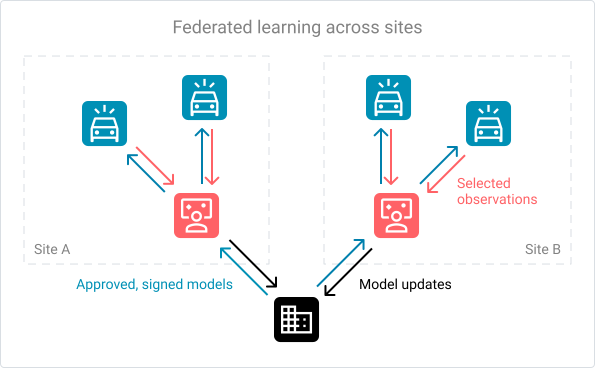
Models improve in the field, on live operational data, and only encrypted weight updates ever leave the device, never the raw data. Scaleout Edge runs the full model lifecycle at the edge: federated training, versioned deployment, resilient operations, and fleet-wide observability.

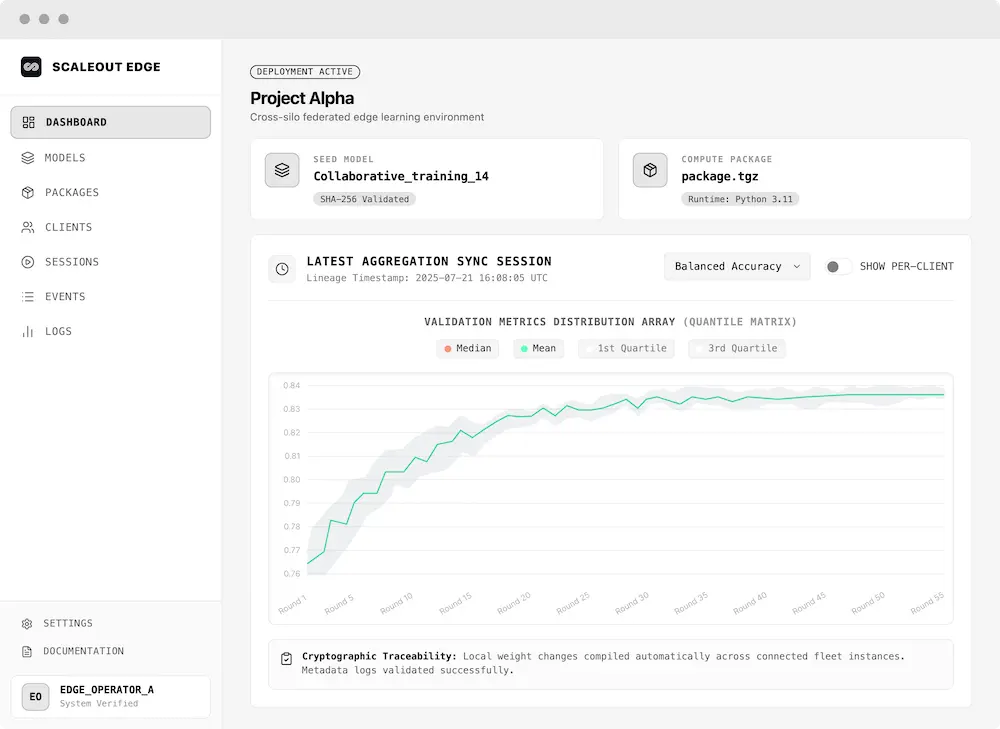
Scaleout Edge AI platform dashboard viewport tool interface

Trusted by leading organisations

BAE Systems logo
Saab logo
NATO logo
FMV logo
Scania logo
The problem

A fundamental constraint. Not a tooling problem.

Standard ML assumes data can be centralised, networks are reliable, and models stay accurate once deployed. At the edge, none of those assumptions hold.

01 // RESIDENCY Data gravity

The data can't move.

Classification boundaries, privacy law, and bandwidth make centralisation non-compliant or impractical. This disqualifies most ML architectures before they start.

Vulnerability: centralisation is non-compliant
02 // CONNECTIVITY Denied links

The network can't be trusted.

Contested environments, remote sites, and mobile fleets operate where connectivity is intermittent or denied. Any system that requires a live cloud link is a single point of failure.

Vulnerability: a live cloud link is a single point of failure
03 // DRIFT Model decay

One model doesn't fit the fleet.

Conditions at the edge change faster than centralised retraining cycles can follow. A model trained on averaged data washes out the local patterns that matter most.

Vulnerability: averaged models wash out local patterns
04 // OPACITY No provenance

The fleet is a black box.

No central record of which model version ran where, what data shaped it, or when it last updated. In regulated or safety-critical systems that's not an ops problem: it's an accountability void.

Vulnerability: no provenance, an accountability void
The advantage

Four dimensions of operational advantage.

Speed, accuracy, reach, and resilience. Each is a direct consequence of training where the data already is, instead of shipping it back to a central model.

Speed

A new pattern at one node becomes a fleet-wide capability in the same operational window.

  • 1 Observe: a new failure mode, object class, or acoustic signature shows up at one node
  • 2 Confirm & retrain: an operator confirms through a simple interface; the model retrains on-site
  • 3 Redeploy: across the fleet within the same window, not the next release cycle

Active learning auto-selects the high-value data; the node retrains locally and verifies before the model is promoted.

Accuracy

Trained on that environment, that site, that operating condition.

  • Real local data: a North Sea platform learns from North Sea conditions, improving as the deployment runs
  • Not a central set that only approximates it

Each node adapts to its local distribution; the federation reconciles those gains into a stronger shared model without raw data moving.

Reach

What one node learns, every node benefits from.

  • One site learns: a new pattern is identified at one site
  • Every node benefits: the model improves across the entire fleet, no raw data leaving any site
  • Collective intelligence that compounds with every deployment, which a centralised loop cannot deliver

Only encrypted weight updates are aggregated across the fleet, model updates orders of magnitude smaller than the raw data, which stays on the device.

Resilience

No persistent uplink required. A disconnected node keeps learning.

  • Connected: full federated training, staging, and observability
  • Intermittent: operates autonomously, queues updates for next sync
  • Disconnected: runs inference, captures data, trains locally. Nothing is lost.

Offline-first by design; compact weight updates sync on reconnect, with minimal bandwidth across constrained, intermittent, or contested links.

How it works · architecture

The model goes to the data. Not the other way around.

Four principles, each a direct response to the constraints that make conventional ML fail at the edge.

Continuous training on live data

Edge nodes train directly on local data as conditions change. No centralised retraining cycles. The platform improves from what it observes, not from what can be sent back.

Only encrypted updates leave the device

Raw data is architecturally confined to the edge. Only model weight adjustments travel, orders of magnitude smaller than the raw data, and they are hardened against inference with secure aggregation and privacy auditing. Sovereignty is enforced by system design, not access-control policy.

Designed for denied connectivity

Nodes train independently and sync when connectivity allows. A node that loses signal continues learning. When it reconnects, its updates merge automatically.

Immutable audit trail across the fleet

Every model version recorded with its compute package hash and session lineage. The accountability chain required for regulated and safety-critical deployments.

Tier 1 Edge clients

Drone

Compute pkg
Local data

Vehicle

Compute pkg
Local data

Sensor

Compute pkg
Local data
Tier 2 Aggregation
Combiner
Combiner
Tier 3 Control layer

Base services

Model registry
API, UI
Observability
Storage, DB
Reducer
Controller
What this is not

Powerful where it counts. Restrained where it matters.

Two deliberate boundaries: your team stays in control of what the fleet learns, and the platform sits inside your existing stack rather than replacing it.

01 / Not autonomous learning

A human confirms before the model learns.

Novel patterns are never folded into the model on their own. A person confirms first, keeping your team in control of what the fleet learns, and how fast. Meaningful human control by design, not a policy bolted on afterwards. Decisions about what to do with a detection stay with your team and your existing systems. The platform governs model improvement, nothing else.

02 / Not a replacement

Sits between your ML environment and your edge fleet.

Scaleout Edge doesn't replace your tooling. It handles the distributed edge execution layer that your existing stack doesn't reach. Your frameworks, cloud platforms, and MLOps stay in place.

Sits alongside
SageMaker Azure ML Vertex AI Kubeflow MLflow
Integration · your stack

Develop centrally. Deploy and train at the edge.

Scaleout Edge sits between your existing ML environment and your edge fleet, handling the distributed execution layer that SageMaker, MLflow, and Kubeflow don't reach.

Develop centrally. Train at the edge.

Build and test models in your existing environment. Automate sessions through the REST API and Python APIClient. Export fleet telemetry via OpenTelemetry to Prometheus, Grafana, or Datadog.

Scaleout Edge Stack Architecture Diagram

Client SDKs

Python, C++, and Kotlin clients under Apache 2.0. Full documentation, API reference, and example projects.

Platform Overview

Motivation, use cases, and the conceptual architecture of the platform.

Documentation

API reference, SDK guides, and deployment documentation.

Server-side Environment Control plane
ML Frameworks & Libraries
PyTorch
Keras
TensorFlow
Scikit-learn
TFLite
ML Platform & Workflow
SageMaker
Azure ML
Vertex AI
KubeFlow
MLFlow
Scaleout Edge Orchestrator

Orchestrate Models & Fleets

Server-side
REST API & Web UI HTTP/REST
Manage sessions, models, and fleet configuration without custom clients.
Model Registry gRPC
Version, validate, stage, and distribute models across nodes.
Observability Backend Realtime
Dashboards for local training loss, on-device metrics, node battery, and lineages.
Cloud & Private Infrastructure

Runs securely on top of physical systems, bare-metal servers, Kubernetes clusters, or commercial private cloud boundaries.

AWS
Oracle Cloud
Kubernetes
Azure Cloud
OpenStack
GCP
Client-side Edge Nodes Fleet
Scaleout Edge SDKs

Constrained Edge Execution

Client-side

Optimized embeddable compilation runtimes with zero external dependencies.

Python SDK v3.11
Full local training & accelerated inference on Jetson, Linux x86 nodes, & servers.
C++ SDK Compiled
Runtime for embedded and resource-constrained hardware.
Kotlin SDK Android
Mobile orchestration optimized for smart devices, hand-helds, and smart terminals.
Built-in Local Telemetry: Automatically logs CPU/GPU compute, battery stats, network signals, and local training epoch loss with zero manual code.
Certified Hardware Targets
NVIDIA Jetson
Raspberry Pi
x86 Edge Server
Android OS
Use Cases

One platform. Four operational contexts.

Distributed data that cannot move and AI that must keep improving.

Tactical Edge

Autonomous Intelligence in Denied Environments

  • On-device training directly on sensor streams. Intelligence at the source.
  • Model updates aggregate across the swarm without raw data crossing classification boundaries.
  • Node loss or signal disruption does not halt the training cycle.
NATO
BAE Systems
FMV
Sovereign Industrial

One Organisation. Many Sites. Data That Can't Leave.

  • Predictive maintenance trained on live sensor streams at each site. No data crosses boundaries.
  • Model improvements federate across a global network of sites when connectivity allows.
  • Per-site data residency met architecturally, not through access controls.
Oracle
Akkodis
Autonomous Transport

Fleet-Wide Learning Without Bottlenecks

  • Safety and intrusion detection improve from each vehicle's data without exposing routes.
  • Only compressed weight updates transmit, orders of magnitude less than raw telemetry.
Traton
Scania
Cross-Jurisdictional

Federated Intelligence Without Data Exchange

  • Collectively train models across institutions without exposing raw data or proprietary information.
  • GDPR and HIPAA compliance enforced architecturally. Data cannot leave jurisdiction.
Banks
Government
Healthcare
Modules

Don't start from scratch.

Pre-built modules for the most common edge AI domains. Model architectures, training configurations, and reference workflows. Compress months of integration into days.

Computer Vision
Module Field Ready

Computer Vision

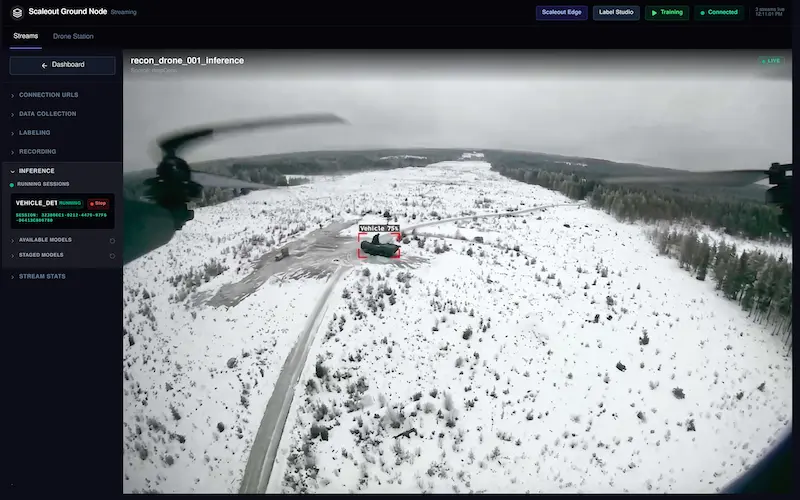
Federated-ready model architectures for detection, classification, and segmentation. Supports continuous improvement of vision models across distributed fleets via federated fine-tuning. Each node learns from its local environment without sharing raw imagery.

Drone and Autonomy
Module Field Ready

Drone & Autonomy

Modular toolkit for unmanned vehicles. On-drone inference with offline caching and sync, autonomous flight ops for recon and engagement, and swarm coordination with ground station integration.

Speech and Language
Module Experimental

Speech & Language

Federated fine-tuning of speech and language models on local private data. Reference workflows for Whisper, wav2vec, and transformer-based LLMs, with edge-optimised deployment targeting hardware like NVIDIA Jetson.

Adversarial Modelling
Toolkit Experimental

Adversarial Modelling

Test whether your federated models leak private data. Privacy auditing covers model inversion, membership inference, and gradient inversion. Adversarial simulations include data poisoning, backdoor attacks, and label flipping.

Pricing

Your infrastructure. Your control. Your models.

Scaleout Edge is deployed as a single-tenant instance under your control, a sovereign edge-learning capability without committing to a large, centralised programme to get it. We scope the deployment with your team, from initial pilot to production fleet.

Enterprise & Commercial

Production deployments

Single-tenant deployment on cloud or on-prem infrastructure. Includes access to all capability modules, dedicated onboarding, and engineering support.

  • Platform subscription covering the control plane, model registry, federated learning engine, and ongoing updates.
  • Per-node runtime licensing for fielded systems, with volume-based tiers.
  • Forward deployed engineering available and scoped separately.
Academic & Research

Free for research

Free licenses for accredited institutions and students for non-commercial research.

  • Full platform access including capability modules.
  • Non-commercial use only.

How pricing works: Pricing adjusts based on deployment scope (active environments and aggregation points), node capacity (concurrent edge devices), and support tier. A natural starting point is a 60-day Stage 1 engagement to establish the lab workbench, demonstrate the full workflow, and jointly define the path to field validation.